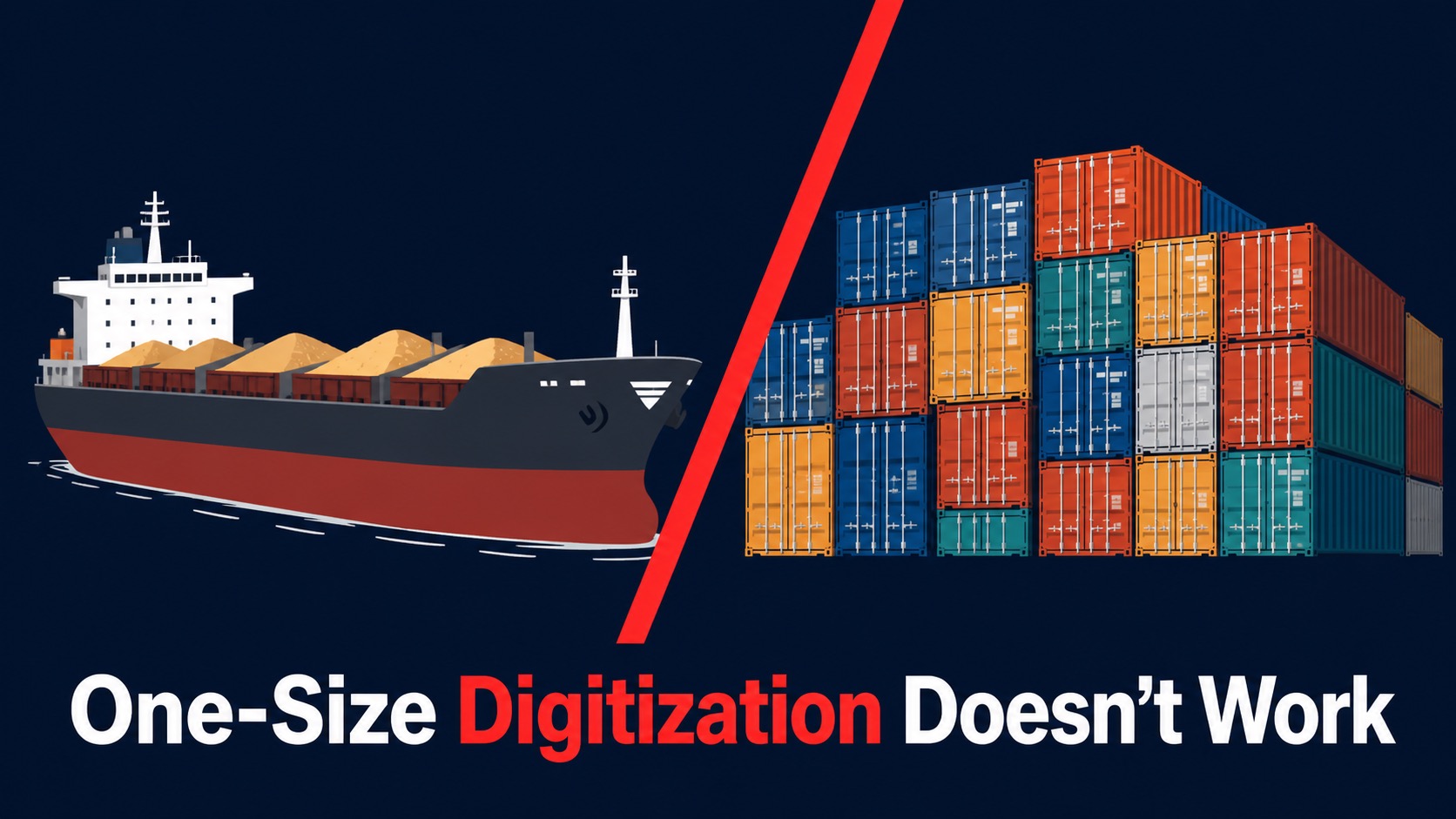
Most logistics digitization projects fail before a single line of code is written.
Not because the technology is wrong. Because the assumptions are.
Here are three assumptions that keep killing projects — and why they’re harder to spot than they look.
Assumption #1: Digitization Has an Obvious Business Case
It doesn’t. Not always.
The instinct is to look at a manual operation and see waste. Paper logs. Handwritten records. People re-entering data. It looks like a problem waiting to be solved.
But manual operations persist for a reason. Cheap, experienced labor handling low-frequency, high-value transactions can be more cost-effective than software that needs constant maintenance and retraining. The math doesn’t always favor automation.
I learned this at a bulk terminal where the existing system — if you could call it that — worked. Nobody on the floor was asking for software. The push came from above. That gap between what management wants and what the floor needs is where most projects quietly die.
The mistake is starting with “we should digitize this” instead of “what specific problem costs us money right now.” Those are very different starting points. The first gets you a system nobody asked for. The second gets you something people will actually use.
Assumption #2: Logistics Is Logistics
It isn’t.
Container and bulk operations look like the same industry from the outside. They aren’t. They have different rhythms, different data needs, and different failure modes.
Container logistics runs on volume. Thousands of boxes. Thousands of scans. Every movement tracked because the number of movements demands it. Automation has obvious ROI.
Bulk runs on weight. One vessel. Tens of thousands of tons. An entire operation might generate fewer data points than a single busy afternoon at a container terminal. The economics of granular tracking simply don’t apply.
I came into the bulk project with container experience. That confidence was the problem. The architecture that works for high-frequency, low-value transactions breaks under low-frequency, high-value ones — not technically, but operationally. The assumptions travel with you whether you notice them or not.
Know which game you’re playing before you design the rules.
Assumption #3: Automation Reduces Work
It often doesn’t. It relocates it.
When you automate the middle of a process, the edges get heavier. The people feeding data into the system and handling exceptions on the other end end up doing more than before. The software looks efficient in a demo. The floor tells a different story.
Before our system, an operator finished a job and marked it done. One step. After — five status updates, each triggering billing logic downstream. Miss one, the whole chain broke. The floor was doing more work than before we started. Nobody put that in the project summary.
This is especially true when input data is messy — and in logistics, it always is. Every shipper sends documents differently. Every carrier has a different format. The mapping rules you build to handle this don’t go away. They accumulate. What starts as a clean solution becomes permanent maintenance work.
Automation is not the end of manual work. It’s a redistribution of it. The question isn’t “can we automate this?” It’s “where does the work go when we do?”
The One Question That Changes Everything
Before any digitization project, ask the people doing the work — not the executives approving the budget — what actually costs them time and money.
The answer is almost never “we need a fully automated system.” It’s usually something specific. A reconciliation that takes three days. A report that’s always wrong. A process that breaks every time a new partner joins.
In our case, the real need was accurate reporting. That was it. We could have built that in a fraction of the time. We built a full system instead.
Solve the actual problem. Nothing more.
The projects that work aren’t the ones with the most ambitious scope. They’re the ones that found the real problem first.