Let’s be honest. Most “competitive intelligence” workflows are a mess — a bunch of browser tabs, a half-baked spreadsheet, and way too many hours spent squinting at obscure government portals.
The problem isn’t that the data doesn’t exist. It absolutely does. Every single shipment that enters a U.S. port is logged in a public record called a vessel manifest. Your competitor’s supplier relationships, order volumes, and sourcing shifts are hiding in plain sight.
The problem is that nobody’s shown you how to piece it all together without spending $500/month on a premium trade data platform.
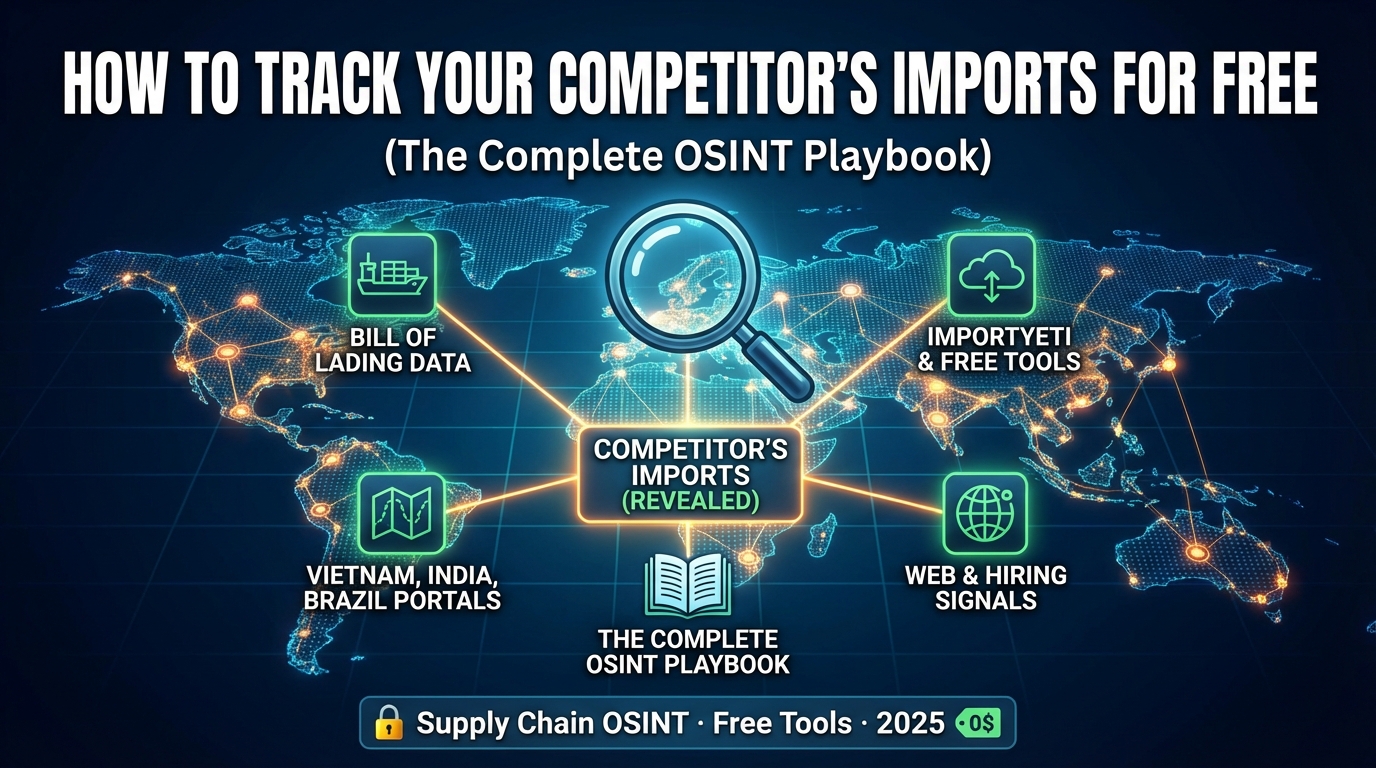
That’s what this post is for. By the end, you’ll have a systematic, zero-budget playbook for tracking what your competitors are importing, who they’re buying from, and when they’re about to make a move.
“The data is public. The insight is the skill.” — Every good trade analyst, ever.
📋 What You’ll Learn
- Why this data is legally public (and what’s in it)
- How to read a Bill of Lading like a supply chain detective
- The best free aggregator tools (ImportYeti & friends)
- Vietnam, India & Brazil — the goldmines most people ignore
- Layering in OSINT signals (hiring, web changes, ads)
- Automating the whole thing with n8n (free, open-source)
- When competitors hide their data — and how to find it anyway
1. The Legal Reason Your Competitor’s Shipments Are Public Record
Here’s the thing most people don’t know: in the U.S., every ocean freight shipment is automatically filed with U.S. Customs and Border Protection (CBP) through the Automated Manifest System (AMS). This is required by law — and under the Freedom of Information Act (FOIA) and 19 CFR 103.31, a significant chunk of that data is publicly accessible.
That means every time your competitor ships a container from a factory in Ho Chi Minh City to the Port of Los Angeles, there’s a paper trail. A very detailed one.
Here’s what’s typically in a vessel manifest record:
| Data Field | What It Tells You | Strategic Value |
|---|---|---|
| Shipper name & address | The actual factory or supplier | 🔥 Identify exact manufacturers |
| Consignee | Who received the goods | Confirm your competitor’s entity |
| HS Code | Standardized product category | Spot product line expansions |
| Weight & quantity | Volume of the shipment | Estimate inventory buildup |
| Cargo description | SKU-level product details (sometimes) | 🔥 Product specs & new SKUs |
One important caveat: companies can file a confidentiality request with CBP to mask their name from public records. But here’s the catch — those requests expire every two years and need to be manually renewed. Plenty of companies forget. We’ll talk about how to exploit that gap in Section 7.
2. Reading a Bill of Lading Like a Supply Chain Detective
The Bill of Lading (BOL) is the single most important document in international shipping. Think of it as the receipt, contract, and confession all in one.
But here’s where it gets interesting for competitive analysis: there are two kinds of BOLs, and understanding the difference is crucial.
Master BOL (MBL)
Issued by the shipping carrier. Often lists a freight forwarder — not the actual importer — hiding your competitor’s identity behind a middleman.
House BOL (HBL)
Issued by the forwarder. Contains the real exporter and importer names — but often isn’t what shows up in public databases first.
So what do you do when you hit a wall of freight forwarder names? You look for patterns. If the same forwarder consistently routes containers of a certain weight class, cargo description, and arrival frequency to the same destination zip code — you can reverse-engineer who the actual importer is with surprisingly high accuracy.
Container numbers are also gold. They’re unique identifiers you can track in real-time on any carrier’s website, letting you reconstruct the full routing path of a shipment.
3. The Best Free Tools for Digging Into Import Data
You don’t need to pay $400/month for Panjiva or ImportGenius. There’s a whole ecosystem of free (or freemium) tools that pull from the same underlying data.
ImportYeti — The #1 Free Tool
ImportYeti is genuinely impressive for a free tool. It covers 70+ million U.S. ocean import records and visualizes supplier relationships in a way that’s actually useful. It’s donation-supported, fully free, and regularly updated.
Here’s what you can do with it:
- Supplier concentration analysis: Find out if your competitor is dangerously over-reliant on one factory. (Spoiler: most are.)
- Import trend tracking: See monthly shipment volume to catch pre-launch inventory buildups or sourcing shifts between countries.
- HS code breakdown: Understand which product categories your competitor is scaling up or winding down.
The workflow is simple: search for your competitor’s company name → review their supplier list → cross-reference with the timeline → repeat for their top 3 suppliers.
Other Tools Worth Having in Your Stack
| Tool | Best For | Free Tier? |
|---|---|---|
| ImportYeti | Supplier mapping, timelines | ✅ 100% free |
| ImportInfo | Port & vessel directory search | ✅ Basic search free |
| Zauba | India & US trade data | ✅ Limited free |
| UN Comtrade | Country-level mirror stats | ✅ Free with registration |
Pro tip: don’t rely on just one. Cross-referencing two or three of these catches data gaps that any single platform will have.
4. Vietnam, India & Brazil — The Data Goldmines Most Analysts Ignore
Here’s a move that 95% of analysts skip: when U.S. import data is murky or anonymized, go to the export side.
This is called mirror statistics — using the exporting country’s official data to fill gaps in the importing country’s records. It works because what one country hides, the other often reveals.
Vietnam Trade Information Portal (VTIP)
Vietnam’s customs authority runs the VTIP, which covers HS code-level export data, FTA eligibility, and trade regulations. You won’t get individual transaction records, but you can determine:
- What FTA benefits your competitor’s Vietnamese suppliers qualify for (which affects their landed cost)
- Whether there are export restrictions on specific product categories
- Average declared export values for benchmarking
Brazil’s Comex Stat
Brazil’s Comex Stat system is shockingly detailed — down to the municipal level. If your competitor sources raw materials from a specific Brazilian state, you can monitor regional supply disruptions (weather events, strikes, political instability) and predict how that will ripple into their production timeline.
India’s DGCI&S Data
India’s trade statistics system provides monthly export/import data at the 8-digit HS code level, broken down by country and port. It’s granular enough to calculate market share shifts over time.
💡 The Mirror Stats Method in Practice
Search your competitor’s known Vietnamese supplier on ImportYeti → note the HS codes → cross-reference on VTIP for declared export values → compare to U.S. customs value records. The delta between declared export value and U.S. import value reveals freight/insurance costs and can expose transfer pricing anomalies.
5. Layering OSINT Signals to Build the Full Picture
Manifest data tells you about physical flows. But to understand your competitor’s strategic intent, you need to layer in other signals.
Website Monitoring
Use Visualping or Google Alerts to track changes on your competitor’s website. When their import volume spikes, watch for:
- New product category pages going live
- “Coming Soon” sections appearing
- Price drops on existing SKUs (inventory they over-ordered)
A big import shipment followed by a price cut 6–8 weeks later? That’s a company using scale to undercut you. You now have 6–8 weeks of advance warning.
Hiring Signals
This one’s underrated. Check LinkedIn or Apollo.io for your competitor’s recent job postings. If they’re suddenly hiring:
- Customs brokers or import coordinators → New trade lanes opening up
- Logistics managers in a specific region → Supply chain shift incoming
- Quality control staff in Vietnam/India → Factory relationship being established
Ad Library Intelligence
Meta’s Ad Library and TikTok’s Creative Center show you exactly which products your competitor is actively pushing right now. Cross-reference that with their recent import records and you can identify which new SKUs they’re betting on before the full launch.
| Signal Type | Free Tool | What to Watch For |
|---|---|---|
| Website changes | Visualping, Google Alerts | Price changes, new pages, exec shuffles |
| Hiring signals | LinkedIn, Apollo.io | New departments, logistics expansion |
| Company news | Owler, Google Trends | M&A activity, funding rounds |
| Ad strategy | Meta Ad Library, TikTok Creative Center | Focus SKUs, campaign messaging |
6. Automating the Whole Thing with n8n (Free & Open-Source)
Here’s the honest truth: if you’re doing all of this manually, you’re spending 10–15 hours a week and still missing stuff. The fix is automation, and n8n is the tool for it.
n8n is an open-source workflow automation platform — think Zapier, but free, self-hostable, and way more powerful. You don’t need to be a developer to use it.
Here’s a basic competitor import tracking workflow you can set up in an afternoon:
WORKFLOW: COMPETITOR IMPORT TRACKER
The result? You go from being a data collector to being a strategic analyst. The grunt work happens overnight. You show up Monday with a briefing waiting in your Slack.
Stack this with Google Sheets’ IMPORTXML and IMPORTDATA functions to build a live dashboard — no paid tools required.
7. When Competitors Hide Their Data — And How to Find It Anyway
Your smarter competitors know their manifest data is public. They’ve filed confidentiality requests with CBP to mask their company name. Here’s why that’s not actually a problem.
The “Notify Party” Loophole
Even when the consignee field says “Confidential,” the Notify Party field — usually a freight forwarder or customs broker — often stays visible. If you track which broker handles a particular volume of “Confidential” shipments that matches your competitor’s typical import cadence, that’s strong circumstantial evidence of who’s behind the curtain.
Supplier-Side Reverse Tracking
Here’s the clever move: search the supplier, not the importer. If you already know (or strongly suspect) which factory in Vietnam your competitor uses, search that factory’s name in ImportYeti. Their shipments to “Confidential” consignees will still show up — and you can cross-reference weight, volume, and container patterns against historical records to confirm the match.
Confidentiality Requests Expire
CBP confidentiality requests must be renewed every two years. Companies miss renewals all the time — which means there are windows where previously hidden data suddenly goes public. Monitoring competitors on a monthly cadence means you’ll catch those gaps when they open.
⚠️ Important Note on Ethics & Legality
Everything in this guide uses legally public information. Vessel manifest data is made available by the U.S. government under FOIA regulations. This is standard competitive intelligence practice used by supply chain teams, consultants, and investment analysts worldwide. Do not attempt to access private or non-public systems.
Putting It All Together: Your $0 Intel Stack
Here’s the full framework, distilled:
The goal isn’t to have perfect data. It’s to have better data than your competitor has about you — and to assemble incomplete fragments into a clear enough picture to make smarter decisions.
The upgrade from “we know they’re importing from Vietnam” to “their Vietnamese supplier concentration increased 15% last quarter, which means they’re probably planning a price cut in 6–8 weeks” — that’s what separates a supply chain intelligence program from a Google Alerts folder.
Start with ImportYeti this afternoon. It’ll take 20 minutes and you’ll probably find something you didn’t know by the end of it.
Frequently Asked Questions
Is it legal to track a competitor’s import data?
Yes. U.S. vessel manifest data is publicly released under FOIA regulations (19 CFR 103.31). Using this data for competitive analysis is standard practice in the logistics, investment, and supply chain industries.
What is the best free tool to find competitor suppliers?
ImportYeti is the most capable free tool available. It covers 70+ million U.S. ocean import records and visualizes supplier relationships at no cost. For non-U.S. data, Zauba (India) and UN Comtrade are excellent supplements.
What if my competitor has filed a confidentiality request?
Search their known suppliers instead of the importer name — supplier export records are often not covered by the confidentiality request. Also monitor the Notify Party field, which frequently remains visible even when the consignee is masked.
How do I automate competitor import tracking?
n8n is an open-source automation platform that lets you build workflows combining HTTP requests, AI analysis (OpenAI/Gemini), Google Sheets logging, and Slack alerts — all for free if self-hosted.
What are mirror statistics in trade analysis?
Mirror statistics refers to cross-referencing the exporting country’s trade data with the importing country’s records. What’s hidden in U.S. import records is often visible in Vietnamese, Indian, or Brazilian export statistics — making it possible to reconstruct full transaction details.
Next Steps
Ready to build your own intel stack?
Go to ImportYeti right now, type in your top competitor’s name, and see what comes up. You’ll have your first insight in under 20 minutes.
Start with ImportYeti →