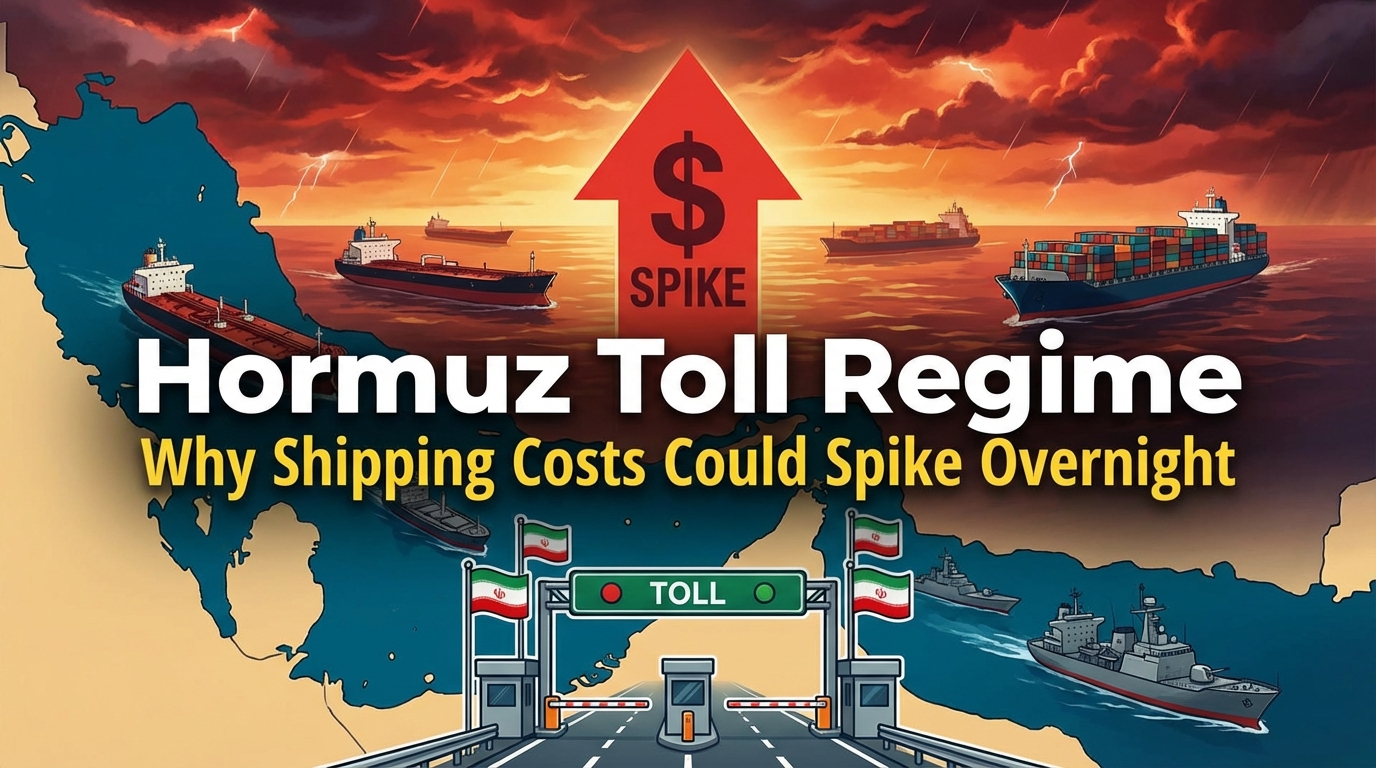
Hormuz toll regime is reshaping shipping costs, insurance, and export risk across global trade lanes. Here is what businesses should do now.
Hormuz toll regime is not just a war story
Hormuz toll regime marks a deeper shift than a temporary wartime disruption. It turns one of the world’s most important maritime chokepoints into an explicitly monetized instrument of political power, and that changes how shipowners, cargo interests, insurers, and energy buyers must think about route risk.
The immediate headline is simple: Iran’s parliament has approved a formal access and toll framework for the Strait of Hormuz, moving passage from implied coercion to codified leverage. But the bigger story sits underneath. When a chokepoint starts charging for access during conflict, freight economics stop being about distance and start being about sovereignty, compliance, and balance-sheet resilience.
This matters because Hormuz is not a niche corridor. It is the valve for Gulf energy exports, tanker availability, war-risk pricing, and downstream industrial input costs across Asia and Europe. Once access becomes conditional, every participant in the chain pays—if not through a direct fee, then through insurance, delay, rerouting optionality, or higher working capital.
Hormuz toll regime changes the price of access
The market’s first instinct is to treat the Hormuz toll regime as another surcharge. That is too narrow. Surcharges can be negotiated, spread across contracts, or diluted in strong freight markets. A politicized toll at a strategic passage is different because it embeds discretion into transit itself.
That discretion is the point. Reports tied to the new regime indicate informal transit charges have already reached as high as $2 million per vessel, while restrictions may extend to ships linked to the US or Israel through ownership, trade, or affiliation. That turns screening, beneficial ownership transparency, and charter-party wording into commercial weapons rather than administrative details. Splash coverage of the Hormuz access regime
The data reveals a structural misalignment: cargo owners still buy logistics as if security were a variable cost, while the corridor now behaves like a strategic asset controlled for geopolitical rent extraction. That gap will punish the least prepared balance sheets first.
Three mechanisms drive this shift. First, tanker operators will demand a premium for legal ambiguity, not just physical danger. Second, cargo owners will pay more for “clean” counterparties and flexible routing. Third, refiners and traders will begin valuing supply assurance over lowest nominal freight.
From seafarer crisis to insurance repricing
The Hormuz toll regime also lands in a labor market already under strain. The Red Sea crisis has dragged on for 865 days, and the UN has warned that the current Hormuz emergency has no post-World War II precedent for seafarers trapped in a war zone. That is not only a humanitarian failure. It is a future crewing cost embedded in today’s voyage economics.
Shipowners can absorb a few weeks of disruption. They struggle more when operational risk multiplies across crew retention, deviation clauses, security protocols, and insurer scrutiny. Once crews view a passage as an unacceptable personal risk, the freight market loses elasticity. Capacity still exists on paper, but not all of it remains commercially willing.
The insurance angle matters just as much. The recent $350 million settlement tied to the Key Bridge insurer settlement shows how quickly marine casualty costs can crystallize into nine-figure liabilities before broader legal questions are even resolved. In the Hormuz context, that precedent matters because insurers will not wait for certainty if exposure is escalating in real time.
The result is predictable: more selective underwriting, sharper war-risk differentiation, and higher compliance demands on charterers. For cargo owners, that means the cheapest freight offer may increasingly be the least bankable one.
Why capital is splitting between defense and reinvention
The Hormuz toll regime is arriving at the same time shipping capital is making two very different bets. One bet is defensive: pay more for optionality, secure tonnage, lock in insurance, diversify gateways, and hold more inventory. The other is transformative: invest in technologies that reduce exposure to carbon rules, energy volatility, and port-side power constraints.
That second trend is easy to dismiss as futuristic. It should not be. Scorpio Tankers’ strategic tie-up with Ampera, backed by a $10 million investment, signals that some owners now see vessel power systems and port energy infrastructure as strategic control points rather than engineering side issues. Scorpio Tankers nuclear propulsion venture
At first glance, a micronuclear shipping project seems unrelated to Hormuz. In reality, both stories point to the same structural truth: the next era of maritime competition will reward control over access, energy, and compliance—not just ownership of steel on the water.
That is why exporters and importers should not read the Hormuz toll regime as a regional anomaly. It is a warning that maritime trade lanes can now be priced politically and financed technologically at the same time. The winners will be the companies that treat logistics not as procurement, but as strategic infrastructure.
✅ Actionable Checkpoints
For shipowners and operators:
– Reprice Gulf exposure voyage by voyage rather than relying on annual assumptions.
– Audit beneficial ownership and sanctions adjacency across fleet employment.
– Revisit crew risk premiums, refusal protocols, and crisis substitution plans.
For cargo owners and traders:
– Stress-test delivered cost models with a direct Hormuz toll scenario and a war-risk spike scenario.
– Diversify procurement contracts toward optional origin points where possible.
– Prioritize chartering counterparties with stronger insurance access and compliance systems.
For investors and lenders:
– Separate owners with true route flexibility from those dependent on politically exposed corridors.
– Watch which firms can pass through security costs without destroying utilization.
– Track energy-infrastructure investments that reduce long-term regulatory and fuel volatility.
Related Analysis: Container Shipping Disruption and the New Cost Map
💡 Mariecon Insight
The Hormuz toll regime exposes a hard truth about global trade: chokepoints are no longer just physical constraints. They are revenue models, diplomatic weapons, and credit risks rolled into one. For B2B markets, this means procurement teams must model political access costs the same way they model fuel and inventory.
For exporters, the warning is clear. If your margin depends on stable transit through strategic waterways, then your real vulnerability is not freight rate volatility—it is concentrated geopolitical dependency. The opportunity, by contrast, sits with businesses that build routing flexibility, stronger counterparties, and enough pricing power to turn disruption into market share.