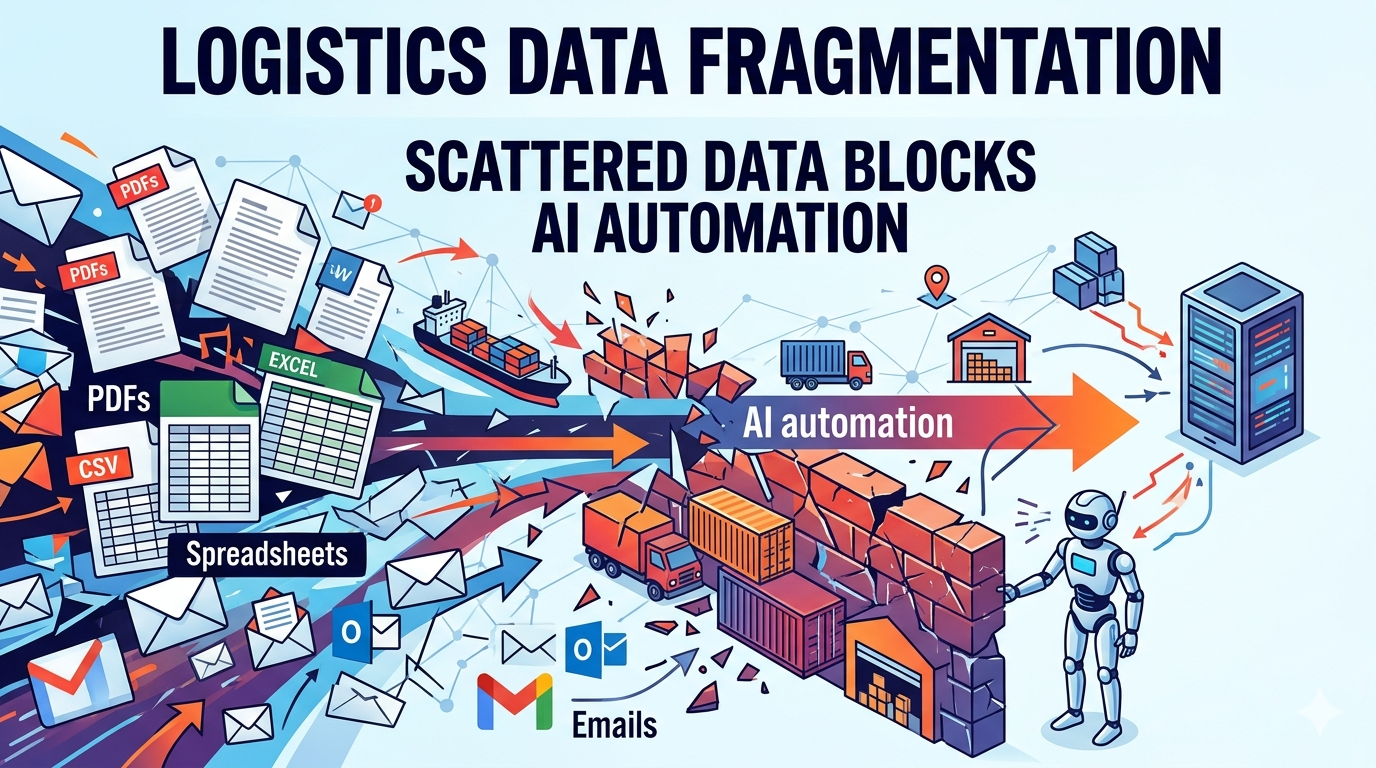
Everyone’s talking about autonomous trucks and blockchain bills of lading. Meanwhile, your ops team is still copy-pasting from a PDF into Excel at 11 PM. Let’s talk about the unsexy reason logistics automation keeps face-planting.
Here’s a number that should make every supply chain executive uncomfortable: 95% of generative AI initiatives at companies have failed to generate any measurable profit, according to MIT’s Project NANDA research released in 2025. And in logistics? It’s arguably worse.
But here’s the twist nobody at the big logistics conferences wants to admit on stage: it’s not the AI’s fault. It’s the data. Specifically, it’s the absolute dumpster fire of fragmented, unstructured, contradictory data sitting in your email threads, PDF invoices, carrier portals, and that one spreadsheet Karen from accounting refuses to give up.
Welcome to what I’m calling logistics data entropy — the slow, expensive heat death of supply chain decision-making. And it’s costing the industry billions.
The Real State of Logistics Data (It’s Bad)
Walk into any mid-sized freight brokerage or 3PL today and you’ll find the same scene: a team of smart, overworked humans manually re-keying information from one system to another. Quote requests come in via email. Bills of lading arrive as PDFs with layouts that change every quarter. Carrier updates live inside proprietary portals that don’t talk to each other. Invoices show up in formats so creative they’d make a graphic designer weep.
One Reddit thread from r/logistics put it perfectly: “logistics is just constant firefighting with no real visibility.” That’s not a tooling problem. That’s a data plumbing problem.
Here’s what the chaos actually looks like in practice:
| Data Source | Why It’s a Mess | What It Costs You |
|---|---|---|
| Email threads | Fragmented context, nested replies, signatures, legal disclaimers as noise | Status updates lag reality; accountability disappears |
| PDF invoices & BOLs | Non-standard layouts that change per partner (and per quarter) | Manual re-entry, billing disputes, settlement errors |
| Carrier portals | Proprietary interfaces, no API, separate logins for each one | “Portal fatigue,” siloed data, missed exceptions |
| Manual Excel files | Version chaos, formula errors, no audit trail | Trust collapse, decisions made on stale numbers |
The “Manual Data Tax” Nobody Budgets For
Let’s talk money, because that’s where this stops being abstract.
According to a 2024 Parseur report, U.S. companies are spending an average of $28,500 per employee per year on manual data entry alone. In freight and logistics, where invoices are notoriously complex and non-standard, that number runs even higher.
Do the math on a 25-person logistics team that spends just 9 hours per week each on copy-paste work. You’re looking at over $700,000 per year burned on humans acting as biological ETL pipelines. And that’s before we count the downstream damage.
| Hidden Cost | What the Data Says | Real-World Impact |
|---|---|---|
| Data error rate (manual) | 1% – 4% of entries | ~$53.50 to fix each error downstream |
| Time wasted | ~40% of the workday | Strategic work and customer service tank |
| Employee burnout / turnover | 56% cite repetitive tasks as a reason to quit | $8,000+ per replacement hire |
| Decision lag | Data is 1+ week behind reality | Margin erosion, missed market shifts |
Gartner has pegged the cost of poor data quality at an average of $12.9 million per year per organization. For logistics — an industry built on multi-party coordination — that number is conservative.
Why Your Shiny New AI Project Is Probably Doomed
Here’s the uncomfortable part. The industry is pouring money into AI like it’s the second coming of containerization. And most of it is going to waste.
The reason? As Supply Chain Today bluntly puts it: garbage in, garbage out. AI models don’t have common sense. They don’t know that “ACME Corp,” “Acme Corporation,” and “ACME LLC” are the same vendor. They don’t know that the missing delay code on 30% of your shipments isn’t actually “no delay.” They just learn from whatever you feed them — and if what you feed them is rotten, you get a model that makes bad decisions, faster, at scale.
This is exactly what Trax Technologies calls the “$100M data quality problem”. The 16% of companies that successfully scale AI aren’t the ones with the fanciest models — they’re the ones who did the unglamorous work of cleaning, governing, and unifying their data first.
Intelligent Document Processing: The Boring Hero
So what actually works? Increasingly, the answer is Intelligent Document Processing (IDP) — and no, it’s not just OCR with a marketing budget.
Modern IDP platforms combine machine learning and natural language processing to read messy documents the way a (very patient) human would. They handle BOLs, proofs of delivery, freight invoices, and rate confirmations with accuracy rates north of 99.5%, according to the 2025 Gartner Magic Quadrant for IDP.
The real magic isn’t the extraction — it’s what happens next. Tools like Hyperscience’s Hypercell for Freight Pay don’t just read the invoice; they cross-check it against your contracts in real time and only escalate the exceptions to a human. That’s the difference between automation and actual leverage.
The EDI vs. API Cold War Is Still Going
Here’s another fun complication: logistics is stuck in a decades-long standoff between EDI (the old, batch-based, rigid standard) and APIs (the new, flexible, fragmented approach). And neither side is winning.
| Feature | EDI (Old Guard) | API (New School) |
|---|---|---|
| Communication style | Batch processing (laggy) | Real-time, event-driven |
| Standardization | Strict, industry-wide | Fragmented per provider |
| Setup complexity | Dedicated networks, painful mapping | Direct cloud integration |
| Best for | High-volume repeatable transactions | Real-time tracking, e-commerce |
As the NMFTA points out, the smartest companies aren’t picking sides — they’re running hybrid strategies. EDI for core transactions with big retailers, APIs layered on top for real-time visibility and customer-facing features.
The Top 5 Freight Invoice Errors Bleeding Your Margins
If you want to find immediate ROI from fixing your data, start here. These are the freight billing errors that quietly cost shippers millions every year:
- Weight and dimension mismatches — Carriers reweigh at the terminal. If your warehouse scales aren’t calibrated, you’re paying reweigh fees and adjustments forever.
- Accessorial creep — Detention, lumper fees, liftgate, residential delivery. These pile on automatically and rarely get audited against actual events.
- Wrong NMFC freight class — A misclassified shipment is an instant billing dispute waiting to happen.
- Outdated contract rates — Carrier billing systems often default to base rates instead of your negotiated tiers. You lose every single shipment.
- Duplicate invoices — Yes, this still happens. A lot. N&C estimates these five errors alone account for the majority of freight overpayments.
The “Boring SaaS” Revolution Nobody Saw Coming
Here’s my prediction for 2026 and beyond: the winners in logistics tech won’t be the companies shouting “AI” the loudest. They’ll be the ones quietly building what one Reddit founder called “boring SaaS that actually outperforms AI everything.”
These tools don’t market themselves as AI. They market themselves as “we cut your data entry time by 10 hours a week” or “we eliminated your billing disputes.” The AI is invisible plumbing, not a billboard. And that’s exactly why they work.
Companies like Incorta are pioneering direct data mapping that bypasses the months-long ETL nightmare entirely, feeding AI models directly from ERPs in real time. That’s the kind of boring infrastructure that actually moves the needle.
So What Should You Actually Do?
If you’re a logistics leader staring down a digital transformation budget for 2026, here’s my unsolicited advice — in order of priority:
- Fix the plumbing before you buy the chandelier. Invest in IDP and document automation before you sign that AI forecasting contract. Clean inputs first, predictions second.
- Treat data as an asset, not exhaust. Assign clear ownership. Build governance. Yes, it’s boring. Do it anyway.
- Chase P&L impact, not dashboards. Pretty visualization tools feel productive. Eliminating $700K in manual entry actually is productive.
- Demand workflow integration, not just visibility. A map showing where your truck is doesn’t matter if your team still calls the carrier to confirm. Force the system to drive behavior, not just display it.
The Bottom Line
Logistics is fundamentally about moving physical things through the real world. But the signals that coordinate all that movement are digital — and right now, those signals are buried under a mountain of PDFs, email threads, and contradictory spreadsheets.
The companies that win the next decade won’t be the ones with the smartest algorithms. They’ll be the ones with the cleanest, most liquid data. Everyone else will keep wondering why their AI investments aren’t paying off, while their best ops people quietly burn out copy-pasting invoices at 11 PM.
Fixing logistics data entropy isn’t the sexiest story in supply chain. But it might just be the most important one nobody’s telling.
What’s your worst data horror story from logistics ops? Drop it in the comments — bonus points if it involves a fax machine in 2026.