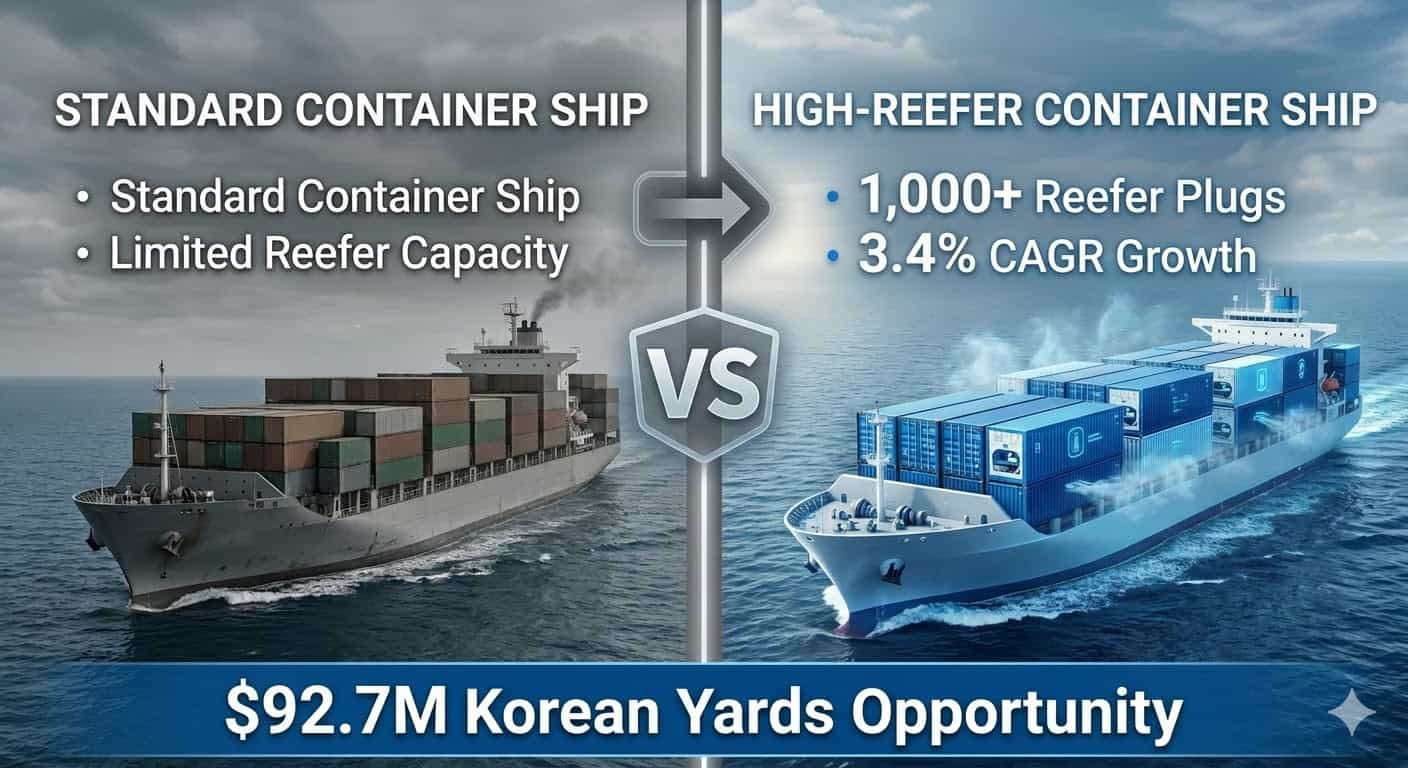
High reefer containerships signal a structural shift in container shipping, creating actionable opportunities for Korean yards, owners, and investors.
High reefer containerships are no longer a niche curiosity; they are becoming a strategic instrument for shipowners seeking pricing power in parts of the container market where cargo sensitivity matters more than sheer slot scale. Euroseas’ decision to order two 2,800 TEU vessels with more than 1,000 reefer plugs each reveals a structural shift: capital is moving toward specialized tonnage that can defend margins even as mainstream container shipping remains vulnerable to cyclical overcapacity.
This matters beyond one Greek owner or one Chinese yard. When a listed tonnage provider commits $92.7 million to a narrowly targeted vessel type, it signals that the next competitive frontier in container shipping is not simply bigger ships or lower unit costs. It is asset specificity—owning the right steel for cargo flows that are harder to commoditize, more temperature-sensitive, and less forgiving of service failure.
For Korean maritime and shipbuilding stakeholders, the deeper question is not whether high reefer containerships are fashionable. It is whether this subsector is becoming one of the few container asset classes where fleet scarcity, regulatory compliance, and cargo growth still align in the owner’s favor.
Why high reefer containerships are attracting capital
The logic begins with trade composition rather than vessel design. Perishable cargo—fruit, seafood, meat, pharmaceuticals, and other temperature-controlled goods—continues to expand faster than much of the dry box market. Drewry’s reefer market analysis indicates reefer container traffic is set to grow at a 3.4% CAGR through 2027, outpacing many conventional cargo segments.
This divergence exposes a fundamental tension: cargo demand is growing in a segment that still suffers from limited availability of modern, specialized tonnage. That shortage matters because reefer cargo does not merely buy transport capacity; it buys reliability, power availability, temperature integrity, and schedule discipline. In such trades, a vessel with 1,000-plus reefer plugs is not just a ship. It is floating cold-chain infrastructure.
The second mechanism is modal consolidation. Drewry’s data also shows container vessels now handle roughly 88% of the perishable goods trade, evidence that specialized reefer ships have steadily ceded ground to liner-compatible boxships with stronger reefer capability. That shift favors owners who can place high reefer containerships into regional and feeder networks where agricultural exports and food imports remain resilient even when discretionary consumer demand weakens.
The third mechanism is regulation. UNCTAD’s Review of Maritime Transport 2024 projects containerized trade growth of 2.7% annually between 2025 and 2029 while emphasizing that fleet renewal is essential under tighter environmental rules. Euroseas’ new vessels are designed to EEDI Phase 3 and IMO NOx Tier III standards, which means the order is not simply about entering a niche. It is about securing commercial relevance in a market where older subscale tonnage increasingly faces regulatory and cost pressure.
What this order reveals about fleet strategy and shipyard economics
At first glance, two 2,800 TEU ships may look modest in an industry still obsessed with mega-vessel headlines. That is precisely why the order deserves attention. High reefer containerships sit in a segment where smaller size can be an advantage because they serve port pairs and regional loops that do not justify ultra-large capacity but do require specialized cargo handling.
Euroseas is paying about $46.35 million per vessel, a level that suggests owners are willing to absorb elevated newbuilding costs when the chartering logic is unusually clear. The economics are straightforward: if modern reefer-heavy tonnage remains scarce by 2028, these ships should command superior employment prospects relative to conventional vessels of similar size. In other words, the owner is not chasing volume. It is buying optionality in a constrained niche.
This also reveals something about Chinese yard competitiveness. Huanghai Shipbuilding’s ability to secure this order indicates that medium-sized specialized containerships remain an arena where Chinese yards can convert design flexibility into market share. Korea dominates the high-value end of global shipbuilding, but not every profitable subsector sits in LNG carriers or ultra-complex offshore assets. If smaller specialized container vessels begin attracting more capital, Korean yards face a familiar dilemma: preserve margin discipline or defend industrial breadth.
The option for up to four additional vessels sharpens the signal. Owners rarely request optionality unless they believe one of two conditions may hold: either asset values will rise, or vessel availability will tighten. In this case, both are plausible. If reefer cargo growth remains firm and environmental regulation accelerates the retirement of older ships, the supply of charterable high reefer containerships could remain structurally thin well into the next cycle.
Related Analysis: HMM feeder strategy: 3 shifts reshaping Korea
The implications for Korean shipping, exporters, and investors
Korea should read this development through the lens of export resilience. Korean maritime strategy often gravitates toward scale, national champions, and premium shipbuilding technologies. Yet refrigerated cargo logistics touch sectors where Korea has direct commercial interests—from food imports and seafood exports to biotech and pharmaceutical supply chains. High reefer containerships therefore represent not only a shipping asset class, but also a supply-chain hedge.
For shipowners, the lesson is that specialization may now offer a better risk-adjusted return than generic fleet expansion. The post-pandemic container cycle punished undifferentiated ordering. Owners who simply added standard tonnage now face weaker charter leverage as deliveries hit the water. By contrast, operators with access to high reefer containerships can target trades where service quality, cargo compatibility, and asset scarcity support earnings durability.
For shipyards, the warning is subtler. Korea’s industrial model rewards technological leadership, but leadership can calcify into a bias toward headline sectors while profitable niche segments migrate elsewhere. If Chinese builders gain experience and references in reefer-optimized feeder containerships, they may gradually strengthen their position in adjacent vessel classes that Korea has treated as strategically secondary.
For investors, one metric deserves close attention: the newbuild-to-fleet ratio within reefer-capable sub-4,000 TEU containerships. If ordering remains disciplined while older ships age out under fuel-efficiency and emissions pressure, charter rates for modern reefer-heavy units could prove more resilient than the broader feeder market. Market incentives dictate that capital will continue to seek these pockets of scarcity.
A reasonable forward view is this: by 2027-2029, charterers exposed to agricultural and cold-chain trades will pay an increasing premium for compliant, fuel-efficient high reefer containerships, especially on regional routes where schedule integrity matters more than maximal scale. That premium may not look dramatic in spot-market headlines, but over a vessel’s employment cycle it can materially alter returns on capital.
[Suggested Chart: Global reefer cargo growth vs. fleet supply of sub-4,000 TEU high reefer containerships, 2024-2029]
💡 3 Key Checkpoints for Korean Maritime/Shipbuilding Stakeholders
- Track niche orderbooks, not just headline tonnage. Monitor the newbuild pipeline for reefer-capable feeder and regional containerships to identify where charter scarcity may emerge before rates visibly respond.
- Reassess yard portfolio strategy. Korean shipbuilders should evaluate whether selective participation in specialized container designs can protect long-term market relevance without diluting margins.
- Build cold-chain shipping partnerships early. Exporters, logistics firms, and carriers should secure medium-term access to compliant reefer-heavy vessels before environmental regulation and asset scarcity push charter costs higher.
💡 Mariecon Insight
The Euroseas order demonstrates that the next profitable chapter in container shipping may belong less to the largest ships than to the most precisely configured ones. High reefer containerships embody a broader market truth: when regulation raises the cost of obsolete tonnage and cargo demand concentrates around reliability-sensitive trades, specialization becomes a form of market power.
For Korea, this creates both warning and opportunity. The warning is that industrial strategy centered only on top-end shipbuilding prestige can miss where commercial scarcity is actually forming. The opportunity is that Korean shipowners, logistics operators, and exporters can still position early in reefer-linked shipping networks, where vessel access may soon matter as much as freight price.
If Korean stakeholders treat this as a minor fleet order, they will miss the underlying signal. If they read it correctly, they will see a sector in which disciplined capital allocation, cargo-specific design, and regulatory timing are beginning to converge. That convergence usually rewards the first movers, not the largest incumbents.